
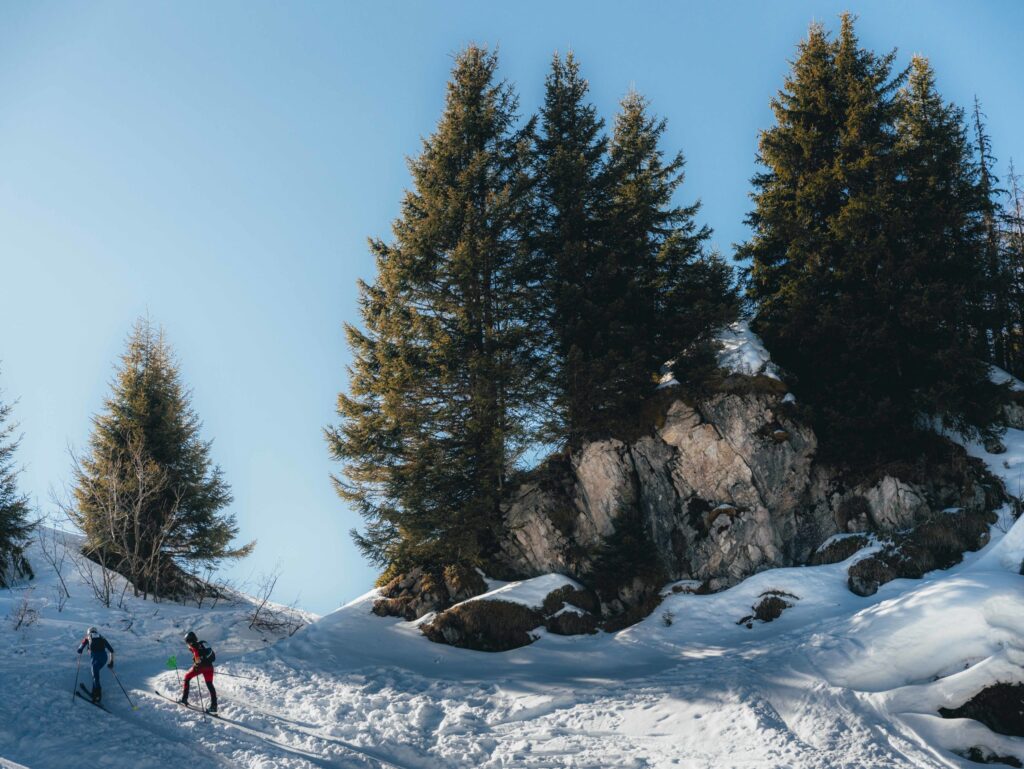
Science and technology are revolutionizing ski mountaineering, offering increasingly advanced tools to enhance athletes’ performance. Recently, the ISMF interviewed two Italian researchers in sports physiology: Prof. Lorenzo Bortolan and Dr. Alessandro Fornasiero from CeRiSM, the Research Center for Sport, Mountain, and Health at the Universities of Verona and Trento. Prof. Bortolan focuses on the technological aspects, while Dr. Fornasiero works on physiology, altitude adaptations, and performance analysis.
CeRiSM is a center of excellence for mountain sports research, with a particular emphasis on endurance sports like ski mountaineering. In this interview, the two experts shared the technological developments and discoveries that are transforming thediscipline, highlighting how research can support both professional athletes and enthusiasts.
The importance of research in athletic preparation
Prof. Bortolan and Dr. Fornasiero explained that studies on ski mountaineering began as early as the 2000s, with pioneering research on the impact of equipment weight on energy expenditure. These studies showed that using lighter boots and skis can significantly reduce the energy expenditure required for climbing, improving locomotion efficiency, a crucial factor for both professional athletes and amateurs.
Today, CeRiSM is one of the leading institutions in applied ski mountaineering research, studying various performance aspects, from biomechanics to high-altitude physiology analysis. The goal is to better understand the factors that contribute to success in competitions and develop specific training methods to enhance performance.
Collaboration with FISI (Italian Winter Sports Federation)
CeRiSM’s collaboration with FISI has created a synergy between scientific research and the athletic preparation of Italian ski mountaineers. This partnership involves regular testing and monitoring of national team athletes, aiming to identify key physiological parameters for performance.
Athletes undergo specific tests at different points in the season, ranging from maximal evaluations in the lab to field assessments during training and competitions. Thanks to a special treadmill that simulates ski mountaineering conditions with real equipment, experts can precisely measure athletes’maximum oxygen consumption, further determining their aerobic and anaerobic thresholds, two critical factors for designing tailored exercise plans.
Shorter, intense races: new challenges in ski mountaineering
In recent years, ski mountaineering competitions have evolved significantly. While endurance over long distances used to be the key to success, shorter and more intense disciplines like sprint and vertical races are gaining ground, especially with ski mountaineering becoming an Olympic discipline.
Dr. Fornasiero emphasized that one of the biggest challenges is understanding how to adapt athletes to these new race formats. CeRiSM’s studies aim to identify the physiological parameters that determine performance in these “quick” disciplines, providing useful training insights.
Another crucial factor is the effect of altitude on performance. Thanks to CeRiSM’s hypoxic chamber, high-altitude conditions can be simulated, allowing researchers to study how athletes cope with the presence of this stressor. This is particularly relevant for races held above 3,000 meters, where the reduced oxygen availability is known to significantly impact athletic performance.
Technology for performance monitoring
With increasingly advanced technology, it is now possible to monitor every aspect of athletes’ performance in detail. CeRiSM uses tools like heart rate monitors and GPS to assess athletes’ physiological responses during training and competitions. In addition to objective data, such as resting heart rate or oxygen saturation, subjective perceptions like sleep quality or perception of recovery are also evaluated on a daily basis.
One interesting example of this research is the development of grass simulations designed to replicate sprint race conditions in the absence of snow. This type of experimentation has garnered international interest, proving useful for off-season training.
Gender physiology in ski mountaineering
Another topic covered was gender differences in athlete physiology. Compared to men, women have lower maximal oxygen consumption values and reduced muscle strength, which affects their performance capability. However, in competitions like sprints and relays, sex differences seem to increase compared to longer races. In these competitions, men and women cover similar distances, which provides an excellent opportunity to analyze sex differences in greater detail.
Data collected from recent competitions have also been analysed to better understand how men and women tackle different sections of the race, especially the ascent, which plays a key role in performance. In addition, a better understating of how to manage exercise intensity and recovery phases has become critical for both categories.
Advice for ski mountaineering enthusiasts
Dr. Fornasiero shared practical advice for ski mountaineering enthusiasts looking to improve their performance. The first fundamental step is undergoing a functional evaluation, which helps assess your fitness level and determine optimal training zones. This can lead to significant improvements by diversifying your training.
Another valuable tip is to monitor your heart rate and pay attention to recovery quality. “Using technology, such as heart rate monitors, can make a difference, even for amateur ski mountaineers,” Fornasiero added.
Future challenges and innovative experimentation
Looking ahead, CeRiSM is working to bring more of the lab into the field, studying athletes in real competition conditions. They are also experimenting with grass courses, an intriguing solution to simulate sprint races during the off-season when snow is less accessible.

Researcher in Sports Physiology at CeRiSM, Research Center for Sport, Mountain, and Health at the Universities of Verona and Trento.

Researcher in Sports Physiology at CeRiSM, Research Center for Sport, Mountain, and Health at the Universities of Verona and Trento